Knowledge Base & Articles
Explore expert tips, material comparisons, structural ideas, and packaging trends to elevate your brand's unboxing experience.
Global pizza sales are expanding, but packaging requirements differ sharply between markets, climates, and delivery systems. For global buyers, Custom Pizza Packaging Boxes must protect heat, shape, flavor, and brand identity during demanding transport. A box leaving a hot kitchen may face condensation, stacking pressure, rough handling, and long customs delays. Defects become costly.
Smithers’ The Future of Global Packaging to 2028 estimates global packaging value will rise from approximately US$1.17 trillion in 2023 to US$1.33 trillion in 2028. Its analysis highlights sustainability, material efficiency, and changing consumer expectations as important market forces. The World Packaging Organisation’s Global Packaging Trends report also points toward recyclable designs, fiber innovation, and responsible sourcing. These findings matter when comparing virgin paperboard, recycled fiber, water-based inks, grease barriers, and certified suppliers. Material choice cannot rely on appearance alone. A practical evaluation should test compression strength, oil resistance, ventilation, print consistency, and food-contact suitability. Buyers should also examine minimum order quantities, sampling procedures, production lead times, pallet dimensions, and documentation.
Experience shows that a beautiful prototype can fail after twenty minutes inside a humid delivery bag. That possibility deserves honest attention. The first sample is not always right. This guide explains how to assess Custom Pizza Packaging Boxes using measurable performance, transparent supplier evidence, and market-specific priorities. It considers box styles, sizing, customization, sustainability claims, logistics, and total landed cost. A recyclable box may still underperform if its coating, ink, or disposal instructions conflict with local systems. Careful buyers ask difficult questions before approving mass production. That discipline protects the pizza, the customer experience, and the investment behind every shipment.
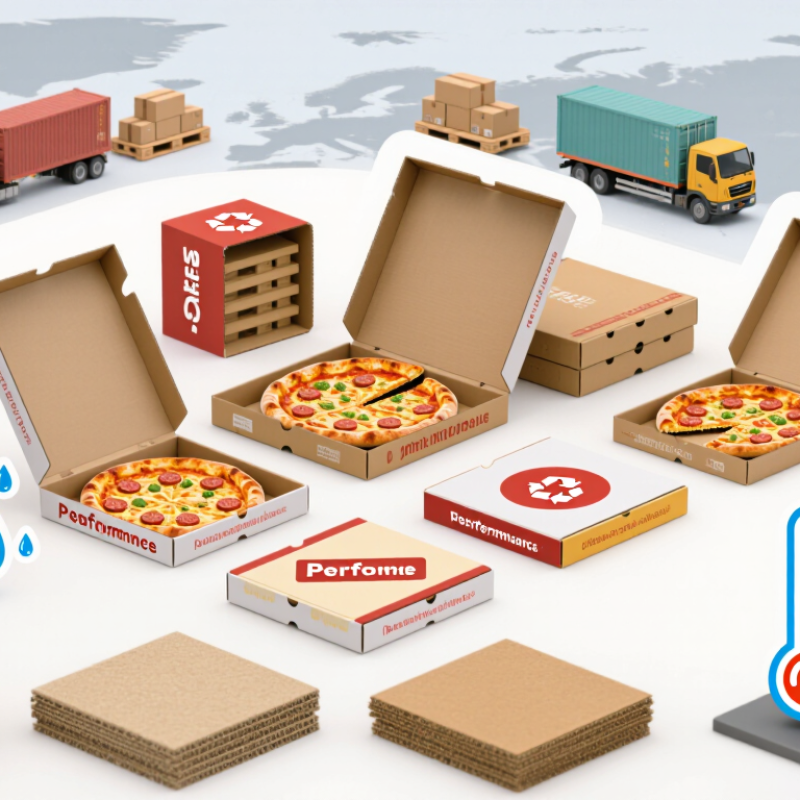
Global pizza packaging requirements begin with food safety, not appearance. Custom boxes should use food-contact paperboard, low-migration inks, and adhesives suitable for heated foods. Destination rules differ. For example, the European Union applies Regulation (EC) No. 1935/2004, while the United States uses FDA food-contact requirements. A single box specification may not satisfy both markets. That assumption can be wrong.
Material recovery also shapes purchasing decisions. The OECD’s Global Plastics Outlook reports that only 9% of plastic waste was recycled globally in 2019. Avoid unnecessary plastic windows, laminated films, and difficult mixed-material coatings. The Smithers report The Future of Sustainable Packaging to 2028 highlights fiber-based formats and recyclability as major packaging priorities. However, “recyclable” depends on local collection systems. A grease-soaked box may be rejected by some paper mills. Test it.
Performance still matters during international shipping. Select board strength for stacked cartons, humidity, and delivery vibration. Vent holes can reduce condensation, but excessive openings may weaken the lid. Food-contact testing, compression testing, and migration testing provide stronger evidence than supplier claims. The International Organization for Standardization’s ISO 18601 series also supports a structured approach to packaging and environmental requirements. Ask for test methods, batch records, and compliance declarations. Do not rely only on a printed recycling symbol. A practical design often uses uncoated or water-based-treated fiber, accurate internal dimensions, and clear disposal instructions translated for each target market. Some compromises remain unavoidable. Reducing material can sometimes reduce protection.
| Packaging Dimension | Typical Requirement | Recommended Specification | Global Buyer Considerations | Quality Check |
|---|---|---|---|---|
| Pizza Size Compatibility | Common round pizza diameters include 10, 12, 14, 16, and 18 inches. |
Allow approximately 10–15 mm of internal clearance beyond the pizza diameter.
10 in: 254 mm 12 in: 305 mm 14 in: 356 mm 16 in: 406 mm 18 in: 457 mm |
Internal dimensions should be used for product fit. External dimensions are important for shipping cartons, pallet planning, and warehouse storage. | Place the largest expected pizza in the box and check that the rim does not touch the sidewalls. |
| Internal Box Height | Height depends on crust thickness, toppings, cheese volume, and whether stacking pressure is expected. | Typical internal height: 35–45 mm for standard pizzas; 45–60 mm for thick-crust or heavily topped products. | A low box can compress toppings and trap steam. An excessively tall box may reduce stacking stability and increase material use. | Check the highest topping point and maintain enough clearance to avoid contact with the lid. |
| Board Material | Pizza boxes are commonly made from food-contact paperboard or corrugated fiberboard. | Use food-contact-grade corrugated board or solid paperboard with suitable grease resistance. E-flute provides a relatively low profile; B-flute provides greater stacking strength. | Material selection should balance rigidity, ventilation, print quality, storage volume, and recycling requirements. | Verify board caliper, edge crush performance, odor, surface cleanliness, and resistance to ordinary handling. |
| Grease Resistance | Pizza releases oil from cheese, meat, sauces, and flavored toppings. | Use a paper-based grease-resistant treatment or an approved functional barrier suitable for direct food contact. | Some markets restrict intentionally added fluorinated grease-resistant substances. Obtain a current supplier declaration for the selected treatment. | Conduct a practical grease-contact test using a hot pizza or a validated oil-contact test method. |
| Steam Ventilation | Hot pizza produces water vapor that can soften the crust and make the box damp. | Use correctly positioned vents or controlled lid perforations while preserving structural strength and heat retention. | Vent design should reduce condensation without allowing excessive heat loss, leakage, or contamination during delivery. | Evaluate condensation, crust texture, lid warping, and grease migration after a representative delivery period. |
| Food-Contact Compliance | Paper, board, inks, coatings, adhesives, and recycled fibers can all affect food-contact suitability. | Request a material specification, food-contact declaration, and supporting test documentation for each component. | Examples of relevant frameworks include EU Regulation (EC) No 1935/2004, EU GMP Regulation (EC) No 2023/2006, U.S. FDA food-contact requirements, and China GB 4806.8 for food-contact paper, paperboard, and paper articles. | Confirm that the documentation covers the actual food type, temperature, contact time, and intended market. |
| Printing and Inks | Custom boxes may use flexographic, offset, or digital printing. | Keep printing on the outside surface whenever possible and use inks and coatings appropriate for indirect or direct food-contact conditions as applicable. | High-coverage dark printing can increase drying time, odor risk, and rub-off risk. Destination-market rules may differ. | Check ink adhesion, scuff resistance, odor, color consistency, and absence of visible ink transfer to the food-contact side. |
| Recycled Fiber Content | Recycled paperboard can reduce dependence on virgin fiber but may require additional controls. | Use recycled content only when the supplier can demonstrate suitable cleanliness, odor control, and food-contact compliance. | Some buyers require recycled-content declarations, chain-of-custody information, or restrictions on certain recovered-fiber sources. | Review migration, odor, visual cleanliness, and batch consistency data before mass production. |
| Closure and Assembly | Most pizza boxes use integrated locking tabs and are delivered flat for efficient storage. | Specify a secure tuck-in or locking structure with smooth folding lines and no exposed sharp edges. | Flat-packed boxes reduce transport volume, but the locking design must remain reliable after repeated handling and temperature changes. | Perform opening, folding, locking, stacking, and drop-handling checks using production samples. |
| Stacking Strength | Boxes may be stacked in restaurants, delivery vehicles, distribution centers, and retail environments. | Select board grade and crease design according to the maximum stack height, box size, pizza weight, and expected humidity. | Humidity can reduce paperboard strength. Export buyers should consider warehouse climate, refrigerated transport, and rainy-season delivery conditions. | Test compression and stacking performance under the expected temperature and relative-humidity conditions. |
| Temperature and Use Conditions | Pizza is commonly packed while hot, often immediately after baking. | Validate the box with the intended food temperature, contact time, oil level, and delivery duration. Do not rely only on room-temperature testing. | Food-contact suitability and structural performance are condition-specific. A box suitable for short delivery may not suit long-distance distribution. | Run hot-fill or simulated-use testing that reflects the buyer's actual operating process. |
| Sustainability Information | Global buyers increasingly request recyclable, fiber-based, or responsibly sourced packaging. | Prefer mono-material paper-based structures where performance permits, and provide accurate fiber, coating, and disposal information. | Recyclability depends on local collection and recycling systems. Avoid unverified claims such as “100% recyclable” without market-specific evidence. | Confirm the disposal claim for each target country and provide supporting declarations where requested. |
| Labeling and Traceability | Buyers may need product identification, batch information, material details, and handling instructions. | Include a batch or lot code, item reference, production date, carton quantity, storage conditions, and relevant recycling or food-contact statements when required. | Label content varies by destination market. Packaging claims must be truthful, legible, and supported by technical documentation. | Check barcode readability, print permanence, language requirements, and traceability from finished goods back to raw materials. |
| Shipping Carton and Palletization | Flat pizza boxes are usually packed in bundles inside corrugated shipping cartons. | Specify bundle quantity, carton dimensions, gross weight, pallet pattern, stretch wrapping, and maximum pallet height before ordering. | Use metric dimensions for international documentation and verify container utilization to control freight cost. | Conduct carton compression, vibration, drop, and moisture-exposure checks representative of the shipping route. |
| Sampling and Production Approval | Custom artwork and structural changes can affect performance even when the basic box style is unchanged. | Approve a physical structural sample, printed proof, and production pre-shipment sample before full-scale manufacturing. | Color proofing alone cannot confirm fit, ventilation, grease resistance, or stacking strength. | Use a written approval checklist covering dimensions, artwork, materials, odor, assembly, and shipping configuration. |
Folding carton board suits short, gentle routes. Corrugated board handles longer or rougher journeys better. Test both with filled boxes.
Measure the pizza, including crust and toppings. Leave about 8–15 millimetres of clearance. A tight lid can scrape toppings.
Small vents release condensation and help limit sogginess. Too many vents cool the pizza quickly. Perfect airflow remains difficult.
Request current food-contact documents, migration results, batch details, and production controls. Inspect odor, color transfer, and surface breakdown after thirty minutes. Clean-looking board proves little.
Test packed boxes at realistic temperatures, stacking pressures, and delivery durations. Record temperature, leakage, weight loss, and deformation. Factory performance can mislead.
Include tooling, minimum quantities, inspections, palletization, inland transport, and damaged-carton risks. A cheaper box may increase complaint costs. Low quotes can mislead.
Review audits, traceable quality records, material specifications, ink declarations, and recent test reports. Confirm documents cover the exact board and coating. Ask for proof.
Clarify responsibility for customs, insurance, duties, and final delivery. Confirm carton dimensions, loading plans, moisture protection, and production schedules. Delays happen.
Not necessarily. Check recycling access in each destination market. Request samples, flat-pack storage details, and local disposal guidance before approval. Recyclable is not universally accepted.
Choosing Custom Pizza Packaging Boxes for global buyers requires a balance of product protection, presentation, compliance, and cost efficiency. Buyers should first assess regional delivery conditions, pizza sizes, stacking needs, and customer expectations. Suitable materials may include food-grade paperboard or corrugated board, while structural designs should provide strength, easy assembly, and secure closure. Box dimensions must support different pizza formats without excessive empty space or unnecessary material use.
Food safety is essential, so packaging should use suitable inks, coatings, and adhesives that comply with applicable regulations. Insulation, grease resistance, and ventilation features can help preserve temperature, texture, and freshness during delivery. Buyers should also compare custom printing quality, branding opportunities, recyclable or compostable options, and overall sustainability. When selecting suppliers, consider production capacity, quality control, certifications, minimum order quantities, unit costs, lead times, and shipping terms. A reliable supplier should clearly communicate specifications and provide samples before large-scale production.