4. Future Procurement Trends & Market Dynamics (2026 – 2030)
The global packaging sector is undergoing a massive transformation driven by supply chain automation, stringent environmental mandates, and AI-optimized inventory management. As enterprise buyers re-evaluate their packaging portfolios, several key trends are redefining the role of Custom Auto Bottom Boxes:
A. Integration with Robotic & Automated Packing Lines (Industry 4.0)
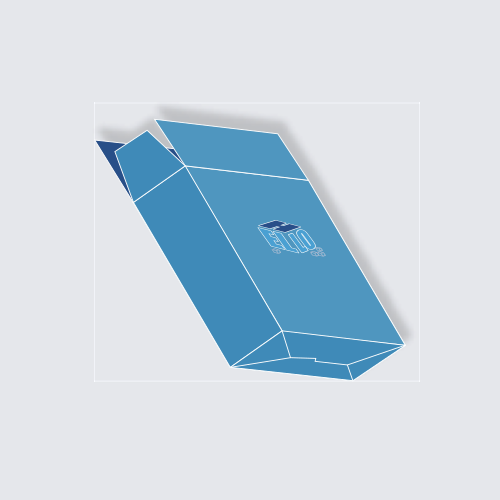
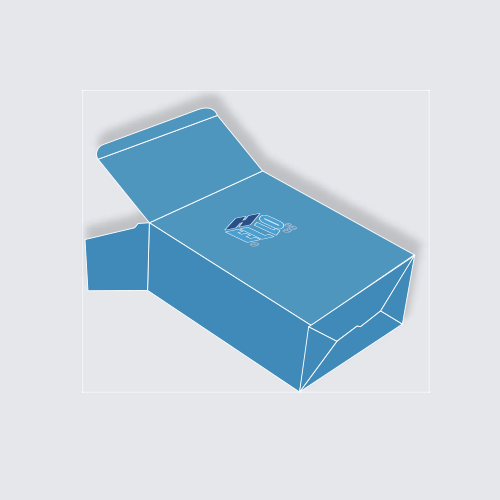
With warehouse labor costs rising globally, fulfillment centers are rapidly deploying cobots (collaborative robots) and automated box erectors. Standard folding cartons with unglued bottoms present high failure rates in automated suction-cup pick-and-place machinery. Custom Auto Bottom Boxes, due to their instantaneous pop-open mechanism, provide near-zero jam rates on automated lines, making them the standard structural format for automated fulfillment facilities.
B. Transition to Bio-Based Cold-Melt Adhesives & Barrier Coatings
Regulatory frameworks across Europe and North America (such as single-use plastic restrictions and PFAS bans) are driving converters to eliminate traditional synthetic EVA glues and plastic lamination. Future auto-bottom production lines utilize bio-polymeric water-based cold glues that maintain high shear bond strength across extreme temperature ranges (-20°C freezer storage to 60°C transport) while allowing 100% repulpability in standard recycling streams.
C. Dimensional Weight (DIM Weight) and Freight Optimization
Major courier networks calculate shipping costs based on volumetric space rather than actual weight. Custom Auto Bottom Boxes allow brands to engineer snug, zero-waste internal dimensions tailored precisely to product contours. Eliminating excess void space reduces DIM weight charges while removing the requirement for plastic bubble wrap inserts.
Strategic Procurement Tip: Standardizing Box Footprints
Enterprise procurement teams can lower master carton tooling expenses by standardizing length and width dimensions across product lines, adjusting only the depth (height) of the auto bottom dieline. This enables unified master carton stacking grids and optimizes pallet loading efficiency by up to 18%.